|
||||
|
Trust Signal
This week's key signals in AI trust and governance:
Our Take The "AI is just a tool" defense is collapsing across three jurisdictions simultaneously. Professional service providers, platform operators, and content generators now face distinct liability frameworks — each requiring different compliance architecture. The professional liability question has arrived. Courts are no longer debating whether AI systems can cross professional boundaries — they're establishing what happens when they do. This week shows three parallel tracks: foundation model providers facing unauthorized practice claims, recommendation algorithms losing Section 230 immunity, and regulatory frameworks closing the "it's just a tool" loopholes. The common thread: liability is moving upstream to system designers, not staying with end users.
|
||||
|
Field Notes
|
||||
|
Lead Story
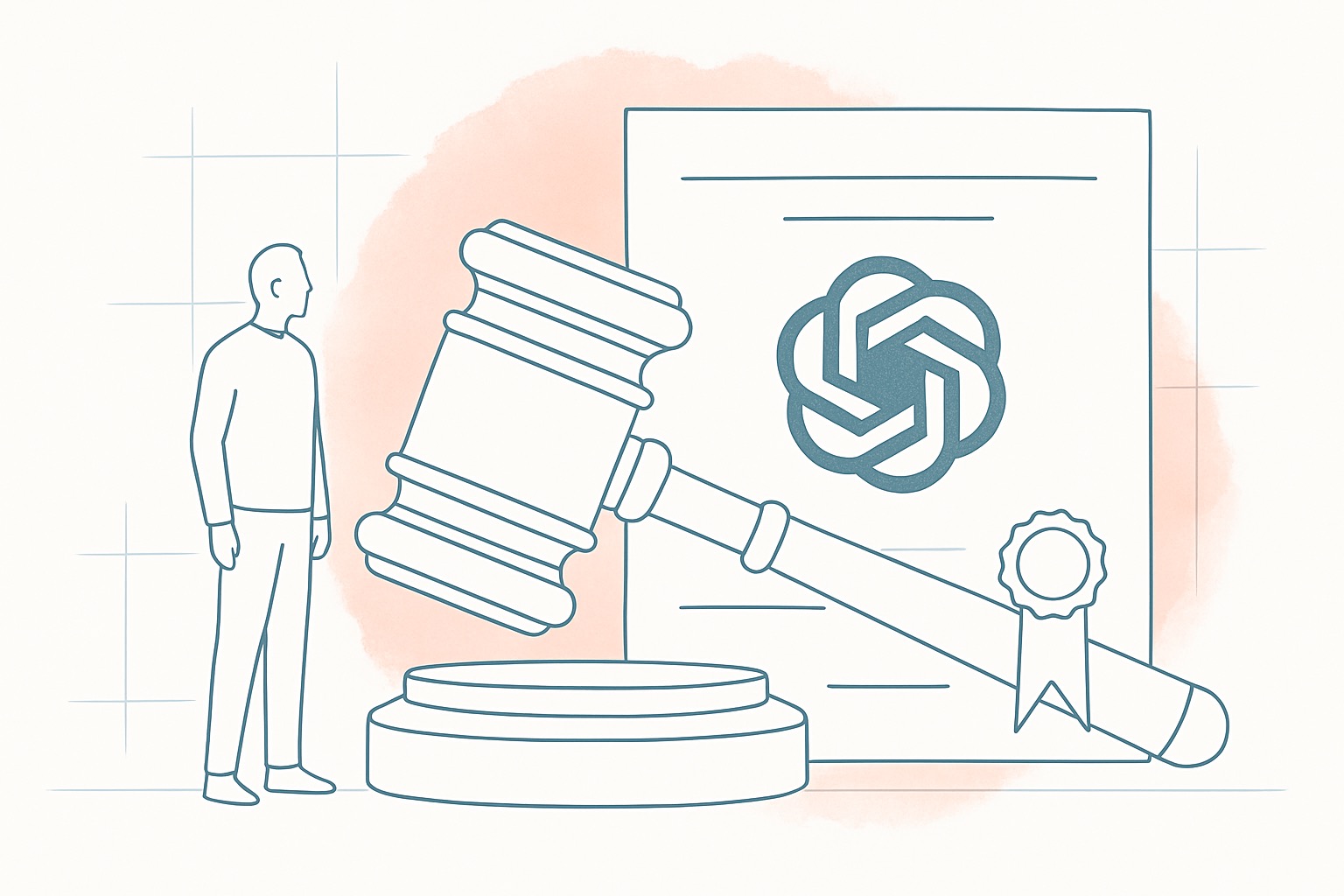
ChatGPT Lawsuit Tests Professional Licensing in AI
|
||||
AI-generated illustration · validant.ai
|
||||
|
||||
|
The Trust Stack
|
||||
|
Fairness Watch
|
||||

AI-generated illustration · validant.ai
|
||||
|
Agency & Action
|
||||
|
Numbers of the Week
|
||||
|
||||
|
||||
|
Inside validant.ai
|
||||
|
Events & Deadlines
|
||||
|
Tool of the Week
ML Test Score rubric — Google's open-source framework for scoring production readiness of machine learning systems across data, model, infrastructure, and monitoring dimensions. Relevant this week because the stochastic ML paper highlights gaps in traditional validation approaches. The rubric includes specific tests for model reproducibility, prediction stability across training runs, and confidence interval coverage — exactly the accountability mechanisms high-stakes systems need. Not a silver bullet, but a structured starting point for teams deploying ML in regulated domains where "it worked in testing" isn't sufficient.
Available: research.google/pubs/pub46555/
Trust Signal is published weekly by validant.ai
Curated by Daniel Glinz | Written by Rex
Subscribe | Archive | Feedback |
||||
|
Dissent
|
||||
|
Full Articles
|
||||
|
Lead Story
ChatGPT Lawsuit Tests Professional Licensing in AI
OpenAI faces a lawsuit alleging ChatGPT engaged in unauthorized practice of law — the first major test of whether foundation models can be held liable for crossing professional boundaries their creators never explicitly programmed them to respect.
The plaintiff claims ChatGPT provided specific legal advice without the required state bar licensure, attorney-client privilege protections, or malpractice insurance coverage. Unlike previous AI liability cases focused on outputs being wrong, this suit argues the act of providing advice itself violated state professional regulation — regardless of accuracy.
Why this matters beyond one lawsuit
Every U.S. state restricts certain activities to licensed professionals: legal advice (attorneys), medical diagnosis (physicians), investment recommendations (registered advisors), engineering assessments (PE licensees), tax guidance (CPAs). These restrictions exist to ensure competence, create accountability chains, and maintain professional standards through continuing education and ethics requirements.
Foundation models cross these boundaries routinely. Ask ChatGPT about a contract clause, and it analyzes legal implications. Describe symptoms to Claude, and it discusses potential diagnoses. Query Gemini about portfolio allocation, and it recommends investment strategies. The models don't check whether you're a licensed professional seeking research assistance or a layperson making high-stakes decisions based on unvetted advice.
The traditional shield — "I'm just providing information, not professional services" — works for publishers and search engines because they don't customize responses to individual circumstances. A legal textbook isn't practicing law because it presents general principles, not advice tailored to your specific situation. But generative AI systems do customize. They analyze your fact pattern, reason through implications, and provide recommendations specific to your circumstances. That's precisely what professional licensing regulates.
The liability chain question
Three parties could face exposure: OpenAI (the foundation model provider), enterprise customers who deploy ChatGPT in professional contexts, and end users who rely on the advice. The lawsuit targets OpenAI directly, arguing the company knows its system crosses professional boundaries and profits from those uses without implementing adequate safeguards.
This creates a precedential framework problem. If courts hold foundation model providers liable for users' professional boundary violations, every model deployment becomes a potential unauthorized practice claim. Medical chatbots, financial planning assistants, tax preparation tools, engineering design aids — all would require either licensing partnerships or aggressive capability restrictions.
But if courts don't hold providers liable, the question shifts to enterprise customers. Did your company create liability exposure by deploying ChatGPT in customer service contexts where it might provide legal, medical, or financial guidance? Corporate legal departments should audit three things immediately: conversation logs showing advice provided in regulated domains, customer-facing AI applications that accept domain-specific queries, and employee-facing tools used for professional decision support.
The precedent cascade
This case arrives as other professional domains face similar questions. Medical AI systems diagnose conditions without physician oversight. Financial planning tools recommend portfolios without registered advisor review. Engineering software validates designs without PE stamps. Each represents a multi-billion-dollar market built on the assumption that AI assistance differs from AI practice.
The distinction matters for enforcement. State licensing boards have clear authority over unauthorized practice but limited technical capacity to detect AI boundary violations at scale. If this lawsuit succeeds, expect a wave of state attorney general investigations — not because enforcement suddenly became a priority, but because a legal framework for liability finally exists.
For AI companies, the risk isn't just damages — it's the compliance architecture required to prevent violations. Building systems that detect and refuse professional services requests across fifty state jurisdictions and dozens of professional domains? That's a filtering and liability problem that makes content moderation look simple.
What this means
Foundation model providers face a new liability category distinct from accuracy, bias, or copyright issues. Professional licensing regulates who can provide certain services, not just whether the advice is correct. Courts must decide whether customized AI responses cross the line from "information provision" to "professional service delivery."
What to do
|
||||
|
Trust Stack
Age Verification Tech Faces Quantum Cryptography Crisis
Age assurance technology balances opposing regulatory demands: child safety laws require reliable age verification, while privacy regulations prohibit collecting unnecessary identity data. Current systems solve this through zero-knowledge proofs — cryptographic methods that verify age without revealing birth dates, identity documents, or other personal information. But quantum computers will break these proofs completely.
Industry expert Allen argues providers must adopt privacy-by-design principles and quantum-resistant cryptography simultaneously, not sequentially. The transition requires retooling entire verification chains: how tokens are generated, how proofs are validated, and how audit trails demonstrate compliance without preserving identifiable data. Providers operating on classical cryptography assumptions face a cliff in 2028-2029 when quantum advantage emerges in relevant domains.
The compliance tension is real. Regulators want audit logs showing verification occurred. Privacy advocates demand systems that can't reconstruct user identities even under legal compulsion. Quantum-resistant architectures with privacy-by-design can satisfy both — but only if implementation happens before current systems become obsolete. Enterprise teams relying on third-party age verification should request quantum readiness roadmaps now, not when migration becomes crisis response.
Source: Biometric Update, March 2026
|
||||
|
Trust Stack
EU Parliament Moves to Criminalize Non-Consensual Deepfakes
Following public backlash against X's Grok AI generating non-consensual intimate imagery, the European Parliament is preparing legislation that criminalizes creation and distribution of sexualized deepfakes — regardless of whether platforms had actual knowledge or technical capability to prevent generation. This represents a significant expansion beyond the Digital Services Act's harm mitigation requirements.
The proposed ban targets both creators and platforms that "facilitate through negligent technical design" the generation of non-consensual synthetic intimate imagery. Unlike existing revenge porn statutes that require proof the content depicts real events, this framework criminalizes fictional but realistic synthetic imagery when it depicts identifiable individuals without consent. The breadth matters: enforcement will extend to foundation model providers whose systems can generate such imagery, not just platforms that host it.
For AI companies, this creates a new compliance obligation distinct from content moderation. Current approaches filter outputs after generation. Criminal liability for facilitation requires preventing generation entirely — technically harder and potentially requiring fundamental model architecture changes. The vote timeline matters: if passed, foundation models operating in EU markets will need generation-blocking capabilities, not just post-hoc filtering.
Source: Biometric Update, March 2026
|
||||
|
Trust Stack
Pakistan Confirms Legal Status of Digital ID
Pakistan issued formal regulatory clarification confirming that digital identity credentials carry the same legal weight as physical identity documents for government services, financial transactions, and authentication purposes. This affects how 240 million citizens can use digital credentials and establishes Pakistan as one of the largest national-scale digital ID implementations globally.
The guidance matters because legal uncertainty is the primary barrier to digital ID adoption. Without explicit regulatory recognition, service providers face liability for accepting digital credentials that courts might later reject as insufficient proof of identity. Pakistan's clarification removes this barrier for government services, banking, telecom registration, and property transactions.
The trust architecture question remains open: how will Pakistan's system handle authentication disputes, credential revocation, and identity fraud? The guidance establishes what digital IDs can do but not how trustworthiness is maintained across the verification chain. International observers should watch Pakistan's implementation for lessons on operating digital ID at massive scale in contexts where physical documents remain prevalent and digital literacy varies widely.
Source: Biometric Update, March 2026
|
||||
|
Fairness
Stochastic ML Systems Challenge High-Stakes Decisions
New academic research examines how stochasticity — the randomness inherent to neural network training — produces meaningfully different models from identical training data. Two models trained on the same dataset with identical hyperparameters will generate different predictions for the same inputs. In low-stakes applications, this variation is noise. In high-stakes contexts — healthcare diagnosis, criminal sentencing, safety-critical systems — this randomness challenges fundamental accountability principles.
Traditional engineering systems are deterministic: given identical inputs, they produce identical outputs. This enables root cause analysis, replication for validation, and clear accountability chains when failures occur. Stochastic ML systems break this assumption. If a medical diagnosis model recommends different treatments based on random initialization rather than clinical evidence, how do we establish whether treatment decisions were appropriate? If a criminal risk assessment scores the same defendant differently depending on model training run, how do courts evaluate whether the score was reliable?
The paper argues high-consequence AI requires new accountability frameworks that account for stochastic variation. Options include: ensemble methods that aggregate multiple model runs to reduce variation, confidence intervals that quantify prediction uncertainty, or deterministic architectures that sacrifice performance for reproducibility. Current regulatory frameworks assume AI systems are deterministic — they require documentation of "the model" as if a single canonical version exists. The reality: every training run produces a slightly different model.
Enterprise teams deploying ML in regulated domains should document not just model architecture but training variability. How much do predictions vary across training runs? What is the confidence interval for any individual prediction? Can your system explain whether a decision reflects genuine signal or training randomness? These questions will become central to AI accountability litigation.
Source: AI & Ethics (Springer), 2026 | DOI: 10.1007/s43681-026-01042-1
|
||||
|
Agency
Voting Rights Groups Challenge Federal ID Database Changes
The League of Women Voters and EPIC filed an amicus brief urging a federal court to reverse recent changes to the SAVE (Systematic Alien Verification for Entitlements) system, arguing the database overhaul was implemented without required privacy impact assessments and threatens to disenfranchise eligible voters through increased identity matching errors. SAVE verifies citizenship status for federal benefits and, increasingly, voter registration.
The brief contends recent system modifications expanded data collection, changed matching algorithms, and increased false-positive rates — all without the Administrative Procedure Act's required public notice and comment period. For voting rights, the concern is concrete: false positives that incorrectly flag citizens as non-citizens create registration barriers that disproportionately affect naturalized citizens, individuals with name variations, and voters in states with strict ID requirements.
The case represents a broader pattern: identity verification systems designed for benefits administration or immigration enforcement get repurposed for voting without adequate consideration of accuracy requirements in the new context. Benefits denial can be appealed; voter disenfranchisement often isn't discovered until Election Day. The court's decision will establish whether federal agencies can modify identity verification systems without assessing impacts on constitutional rights.
What this means for AI trust: repurposing trained systems for new high-stakes applications requires fresh validation that accuracy, error patterns, and failure modes are acceptable in the new context — not just the original one.
Source: EPIC, March 2026
|
||||
|
Agency
Ninth Circuit Narrows Section 230 for Recommendation Algorithms
In McCarthy v. Amazon, the Ninth Circuit allowed wrongful death lawsuits to proceed against Amazon for allegedly recommending and bundling products used in suicides. The court held that Section 230's liability shield — which protects platforms from user-generated content — doesn't automatically extend to algorithmic recommendations that actively promote harmful product combinations.
The distinction matters: hosting third-party content (protected) differs from curating, recommending, and bundling content through algorithmic systems (potentially unprotected). Amazon's "frequently bought together" and recommendation features don't just display products — they analyze purchase patterns and actively suggest combinations. When those combinations constitute a harm (in this case, a "suicide kit"), the platform may face liability for its curation decisions.
This ruling arrives the same week another Ninth Circuit panel partially upheld California's Age-Appropriate Design Code, rejecting arguments that Section 230 immunizes platforms from design regulation. Together, these decisions establish a framework where platforms retain immunity for user content but face liability for system design choices that amplify harm.
For AI companies, the implication is clear: recommendation algorithms, content ranking, and bundling logic represent design decisions subject to tort liability — not protected publishing functions. Your recommendation system's output is your speech, not your users'. Audit what your algorithms actively promote, not just what they passively host.
Source: EPIC, March 2026
|
||||
|
Agency
California Design Code Survives Section 230 Challenge
In a significant blow to Big Tech's broad immunity arguments, the Ninth Circuit allowed most provisions of California's Age-Appropriate Design Code to take effect, rejecting claims that Section 230 or the First Amendment prohibit regulating platform design features that affect minors. The law requires platforms to assess whether their services could harm children and implement age-appropriate defaults for privacy settings and algorithmic features.
The court distinguished between regulating what platforms publish (protected speech) and how they design features (regulable business practice). Requiring privacy-protective defaults, limiting data collection from minors, and restricting certain design patterns doesn't compel or restrict speech — it regulates the commercial architecture through which speech is delivered.
This framework matters beyond child safety. If design features are regulable business practices, not protected speech acts, then state legislatures can mandate fairness assessments, require algorithmic transparency, or prohibit certain recommendation patterns without triggering First Amendment strict scrutiny. The narrow immunity approach creates space for algorithmic accountability regulation that the broad immunity theory would have foreclosed.
Enterprise teams should prepare for design-focused regulation across domains. Age-appropriate design is just the first application. Expect similar frameworks for algorithmic bias, misinformation amplification, and harmful content promotion — all framed as design regulation rather than speech restriction.
Source: EPIC, March 2026
|
||||
|
Further Reading
|
||||
|