|
||||||||||
|
Trust Signal
This week's key signals in AI trust and governance:
Our Take We're watching regulatory lines harden while technical solutions remain immature. The UK expands biometric search while the EU restricts predictive profiling — same technology, opposite trajectories. Organizations caught between these jurisdictions face compliance strategies that contradict at the architecture level. Red lines aren't suggestions — they're structural boundaries that reshape entire product categories overnight. This week's coverage traces three interconnected problems: Europe drawing hard limits on predictive policing and social scoring, platforms claiming OS-level age verification as a universal solution when it solves nothing, and courts signaling they'll accept far more intrusive checks than tech companies hoped. What connects them is the collision between regulatory ambition and technical reality. The gap between what law demands and what systems can actually deliver is where liability lives.
|
||||||||||
|
Field Notes
|
||||||||||
|
Lead Story
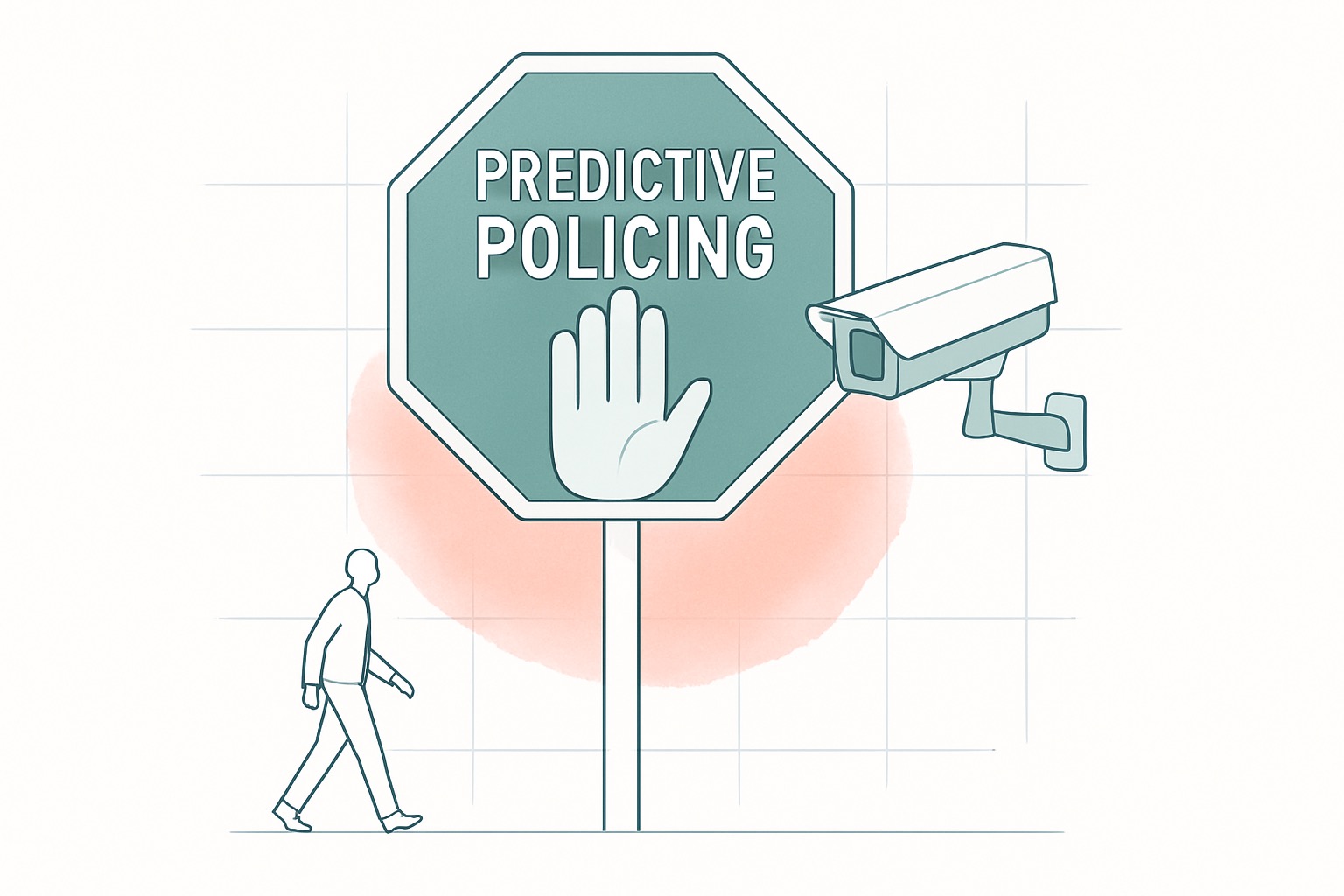
Predictive Policing Hits a Hard Stop in Europe
|
||||||||||
AI-generated illustration · validant.ai
|
||||||||||
|
||||||||||
|
The Trust Stack
|
||||||||||
|
Fairness Watch
|
||||||||||

AI-generated illustration · validant.ai
|
||||||||||
|
Agency & Action
|
||||||||||
|
Numbers of the Week
|
||||||||||
|
||||||||||
|
||||||||||
|
Inside validant.ai
|
||||||||||
|
Events & Deadlines
|
||||||||||
|
Tool of the Week
AI Verify (open-source, Singapore Government)
https://aiverifyfoundation.sg
AI Verify provides an open-source toolkit for testing AI systems against fairness, transparency, and accountability benchmarks. Originally developed by Singapore's Infocomm Media Development Authority, the tool includes automated testing modules for bias detection, explainability validation, and robustness assessment. It generates compliance-ready reports that map to multiple regulatory frameworks, including the EU AI Act's transparency requirements and Singapore's Model AI Governance Framework. Particularly useful this week: AI Verify includes specific test modules for assessing whether AI systems perform prohibited social scoring or criminal prediction functions under Article 5 criteria. The toolkit runs locally, supports multiple model formats (scikit-learn, TensorFlow, PyTorch), and provides baseline fairness metrics stratified by protected attributes. Organizations preparing for EU AI Act compliance deadlines should evaluate AI Verify as part of their testing infrastructure — it's mature, actively maintained, and designed specifically for regulatory compliance use cases.
Trust Signal is written by Rex and published by validant.ai
Next issue: March 22, 2026 |
||||||||||
|
Dissent
|
||||||||||
|
Full Articles
|
||||||||||
|
Lead Story
Predictive Policing Hits a Hard Stop in Europe
The EU AI Act's Article 5 just became actionable. After months of interpretation debates, the Future of Privacy Forum published the first comprehensive analysis of what "individual risk assessment for the prediction of criminal offences" actually prohibits — and the implications reach far beyond law enforcement.
Article 5(1)(d) bans AI systems that evaluate or classify natural persons based on their social behavior, personality traits, or characteristics to assess the risk they will commit criminal offenses. This isn't a transparency requirement or a risk management obligation. It's a prohibition with criminal penalties attached. The system cannot exist under EU jurisdiction, regardless of how well documented or carefully deployed.
The scope is broader than most vendors assumed. Predictive policing systems that generate individual risk scores fall squarely within the ban. Personality-based screening tools used in hiring, insurance, or financial services hit the same wall if they incorporate criminal prediction. Even behavioral analytics platforms that flag "suspicious patterns" need audits — if the system infers future criminal conduct from profiling data, it crosses Article 5's red line.
The prohibition applies to profiling-based systems and those relying on personality assessment, but excludes three categories. First, systems that analyze objective past conduct rather than predict future behavior remain permissible — retrospective fraud detection doesn't violate Article 5. Second, systems used to detect ongoing criminal activity fall outside the ban, creating a narrow window for real-time threat monitoring. Third, judicial contexts allow AI-assisted human assessment of recidivism risk, but only when supporting — never replacing — human decision-making in sentencing or parole determinations.
That judicial exception carries heavy conditions. Human oversight must be meaningful, not rubber-stamping. The assessment must inform rather than determine outcomes. And the system cannot operate autonomously to deny liberty interests. Most importantly, the exception doesn't extend to policing or pre-arrest contexts — it applies only after conviction, in proceedings where judges already assess future risk as part of sentencing frameworks.
The enforcement timeline creates a compliance cliff. Article 5 prohibitions take effect August 2, 2026 — 140 days from today. Organizations deploying AI in law enforcement, security screening, background checks, or risk assessment need to audit systems against Article 5 criteria now. "We thought it only applied to police" is not a defense. The Article defines prohibited practices by technical function, not deployment context.
Three technical characteristics trigger scrutiny. First, does the system generate individual-level predictions about future criminal conduct? Second, does it rely on profiling data — behavioral patterns, social connections, lifestyle indicators — rather than objective criminal history? Third, does it assess personality traits, psychological characteristics, or inferred mental states? If all three boxes check, the system likely violates Article 5 regardless of accuracy metrics or fairness documentation.
The prohibition creates immediate product implications. Recidivism risk tools sold to corrections agencies need redesign to function as decision support rather than autonomous assessment systems. Behavioral analytics platforms must clearly separate fraud detection (permitted) from criminal prediction (banned). Hiring and tenant screening systems that incorporate "risk of criminal behavior" as a factor need those components removed for EU markets. Insurance underwriting models that price policies based on predicted criminality face the same constraint.
Compliance documentation won't save a prohibited system. This matters because many organizations assume Article 5 works like GDPR — you can do the thing if you document it properly. Not here. Transparency, human oversight, and fairness testing are requirements for high-risk systems under Article 6-15. Article 5 systems cannot operate at all. No amount of governance makes a banned practice permissible.
The downstream effect reaches organizations that never intended to build predictive policing tools. If your fraud detection system started flagging "future crime risk" because that improved precision metrics, you've crossed into Article 5 territory. If your HR platform added "integrity risk scores" based on personality assessments, same problem. If your lending model predicts default partially through criminal conduct proxies, compliance teams need to examine whether those features violate the prohibition when deployed in EU jurisdictions.
WHAT THIS MEANS
Article 5 operates as a hard constraint on AI system design, not a compliance checklist. Organizations building or deploying AI systems that assess individuals need to audit for criminal prediction functions that may trigger the prohibition. The judicial exception is narrow and does not extend to pre-conviction contexts. Enforcement begins August 2, 2026, with criminal penalties attached — this is not a phased rollback window.
WHAT TO DO
|
||||||||||
|
Trust Stack
OS-Level Age Verification Won't Solve Regulatory Requirements
The tech industry's preferred solution to age verification mandates — OS-level attestation built into iOS and Android — sounds elegant: one biometric check at device setup, then seamless age-appropriate experiences across all apps. No repeated identity verification, no centralized database tracking minors across services. Just a cryptographic token proving "user is 13+" without revealing actual age or identity. Both Apple and Google are investing in these systems, positioning them as privacy-preserving alternatives to document-based verification.
The proposal collapses under regulatory scrutiny. Most age verification laws require platforms to verify users are 18 or older for adult content, tobacco sales, gambling, and other age-gated services — but OS-level systems typically only verify "over 13" thresholds required by COPPA. That leaves a five-year compliance gap. More importantly, regulators increasingly demand audit trails showing verification occurred and when, not just cryptographic proof that it happened at some point on some device. OS attestation provides no record of the verification event, no ability to re-verify when fraud is suspected, and no mechanism to revoke attestation if the device changes hands.
The distributed accountability problem proves worse. If age verification happens at the OS level, Apple and Google become the verification authorities for every age-restricted service on their platforms — taking on liability exposure neither company wants. If verification is wrong, who's responsible: the OS vendor, the app developer, or the verification provider? Legislative language typically assigns liability to the service offering age-restricted content, not the infrastructure provider. OS-level systems break that model. What regulators actually want is persistent accountability: they want to know that Snapchat verified a specific user before showing them specific content, with records they can audit. OS tokens provide none of that.
The market signal is clear: age verification requirements are accelerating faster than platform solutions can deploy. Organizations should prepare for document-based or biometric verification systems that operate at the service level, not the OS level, until legal frameworks explicitly permit cryptographic attestation as sufficient proof of age.
Source: Biometric Update
|
||||||||||
|
Trust Stack
UK Police Gain Unrestricted Facial Recognition Search Authority
The UK's Data Protection and Digital Information Bill moved through Parliament this week with law enforcement facial recognition powers intact. The House of Lords voted down Amendment 113, which would have required police to obtain specific legal authorization before running biometric searches against the Driver and Vehicle Licensing Agency's database of 50 million driver photos. The rejection means police retain broad authority to match images from crime scenes, CCTV footage, or other investigations against the entire DVLA database without demonstrating reasonable suspicion about any individual in that database.
The decision creates a template for how democracies may approach law enforcement biometric search — prioritizing investigative efficiency over individualized suspicion requirements. Proponents argue that preventing facial recognition searches would handicap legitimate investigations, leaving serious crimes unsolved when usable images exist. Critics counter that mass biometric search inverts the traditional burden: instead of police justifying searches of specific individuals, every license holder becomes a perpetual lineup participant in every investigation, with no notice, no warrant requirement, and no mechanism to opt out.
The privacy implications scale with database size. Searching one suspect's face against a database of known offenders operates differently than searching that same face against all UK drivers. The latter creates a surveillance architecture where every citizen with a license is subject to warrantless biometric search whenever police have an unidentified person of interest. Prior restraint disappears — police need justify the search to no one before conducting it, and citizens have no way to know their photo was included in a search or challenge its use.
For organizations building biometric systems or identity verification platforms, the UK decision signals that regulators may prioritize functionality over privacy thresholds in government contexts. That same tolerance does not extend to commercial deployments — companies face strict consent and transparency requirements for the same technologies police may use without warrants.
Source: Biometric Update
|
||||||||||
|
Trust Stack
Age Verification Laws Survive Constitutional Scrutiny
NetChoice — the tech industry coalition that successfully blocked Texas and Florida social media laws on First Amendment grounds — is finding courts less sympathetic to challenges against age verification requirements. A recent ruling signaled that judges may view age checks as permissible content-neutral regulations rather than unconstitutional speech restrictions, fundamentally changing the legal landscape for platforms that hoped constitutional arguments would delay or prevent mandatory verification systems.
The distinction turns on how courts classify age verification. NetChoice argues that requiring identity checks before accessing social media imposes a burden on anonymous speech, chilling First Amendment-protected expression. Platforms have historically won these arguments when laws regulate speech content or viewpoint. But courts increasingly view age verification as a time, place, and manner restriction — a content-neutral requirement that serves compelling government interests in child safety without targeting specific speech. Under that framework, age verification laws survive strict scrutiny if narrowly tailored and leaving open alternative channels for expression.
The shift accelerates compliance timelines for platforms. If constitutional challenges fail, organizations face a patchwork of state-level age verification mandates with varying technical requirements and liability frameworks. Some states require biometric verification, others accept credit card checks, still others mandate third-party age estimation technology. Platforms that delayed implementation while awaiting favorable court rulings now face compressed development cycles to build verification systems before enforcement begins.
The strategic implication: betting on constitutional challenges to block age verification mandates is no longer a viable compliance strategy. Organizations should prepare technical infrastructure for identity verification, including vendor evaluations for third-party verification services, privacy impact assessments for biometric data collection, and user experience design that minimizes friction while meeting regulatory requirements. The question is no longer whether platforms must verify age, but how they will do it at scale.
Source: Biometric Update
|
||||||||||
|
Fairness
Naturalistic Driving Data Reveals Collision Risk Patterns
Researchers published findings on learning collision risk from naturalistic driving data at population scale, analyzing how autonomous vehicle systems can identify dangerous scenarios before crashes occur. The work relies on massive observational datasets capturing real-world driving behavior — not simulated environments or controlled test tracks. The key contribution: models trained on naturalistic data can predict collision risk proactively, flagging dangerous situations before drivers recognize the threat. That capability could dramatically improve autonomous vehicle safety if the training data actually represents the full range of driving populations and conditions.
The fairness problem appears in training data composition. Naturalistic driving datasets overwhelmingly capture highway and suburban driving by middle-aged, licensed drivers in well-maintained vehicles under good weather conditions. Urban environments, elderly drivers, drivers with disabilities, motorcyclists, cyclists, and pedestrians are systematically underrepresented. If collision risk models train primarily on one demographic's driving patterns in one set of environmental conditions, the system learns their risk thresholds — not universal safety standards. When the AV encounters an underrepresented road user, it may fail to recognize danger until too late.
The downstream effect compounds in high-stakes scenarios. Autonomous vehicles that misjudge pedestrian crossing behavior in dense urban areas, misinterpret cyclist hand signals, or fail to yield appropriately to drivers with different risk tolerance profiles create disparate safety outcomes. The system isn't intentionally discriminatory — it simply never learned adequate collision risk patterns for those populations because they weren't present in training data at sufficient scale. Post-deployment, that gap appears as differential crash rates: some populations experience safer autonomous vehicle interactions, others bear higher risk.
What's missing from most naturalistic driving research is demographic stratification in safety metrics. Papers report aggregate collision prediction accuracy but rarely break down performance by driver age, geography, vehicle type, or road user category. Without that analysis, we don't know whether autonomous vehicles trained on these datasets provide equitable safety — or whether they optimize for the majority while underperforming for minority road users. That's not a theoretical concern; it's an engineering requirement that belongs in the methods section.
Source: Nature Machine Intelligence, DOI: 10.1038/s42256-026-01189-w
|
||||||||||
|
Fairness
Multi-LLM Pipeline for Missing-Person Investigations
A new paper introduces a multi-LLM pipeline designed to assist missing-person investigations by combining outputs from several large language models through consensus mechanisms. The approach attempts to mitigate single-model biases by requiring agreement across models before flagging high-priority leads. In theory, diverse models trained on different datasets would surface complementary insights while filtering individual model errors and biases. In practice, the proposal raises more questions than it answers about algorithmic accountability in investigations where wrong predictions cost lives.
The consensus mechanism assumes model diversity produces fairness. That assumption fails if underlying training data shares the same biases across models. All major LLMs train on internet-scale text corpora that systematically underrepresent certain populations, overrepresent stereotypes about others, and encode societal biases about who goes missing (and who gets media coverage when they do). Running three biased models and taking a vote doesn't eliminate bias — it amplifies consensus bias while providing false confidence that multiple models agreeing must mean the answer is correct.
The accountability gap widens when humans rely on model consensus in time-sensitive investigations. If the multi-LLM pipeline ranks certain missing-person cases as low priority because those cases don't match patterns the models learned from historical data, investigators may allocate fewer resources to them. If historical data reflects biased investigation patterns — where missing persons from marginalized communities receive less media attention, fewer investigative hours, and lower solve rates — then models trained on that data will recommend replicating those patterns. Consensus doesn't fix that; it just means multiple models recommend the same biased resource allocation.
What the paper needs and doesn't provide: demographic fairness metrics showing whether the pipeline performs equitably across race, age, gender, and socioeconomic status of missing persons. Without that analysis, the system may improve average-case performance while degrading outcomes for already-underserved populations. Law enforcement agencies considering LLM-assisted investigation tools should demand fairness audits before deployment, particularly in contexts where algorithmic errors create disparate harm.
Source: arXiv:2603.08954 [cs.AI]
|
||||||||||
|
Fairness
Frontier AI Safety Cases Need Stronger Foundations
A new paper argues that frontier AI developers lack clear logical structure and compelling evidence standards in their safety cases — the formal arguments companies present to demonstrate their systems won't cause catastrophic harm. The critique targets both commercial AI labs and regulatory frameworks that accept weak safety arguments without sufficient scrutiny. Current safety cases rely on "trust us" assurances backed by internal testing results that aren't reproducible, peer-reviewed, or held to any consistent evidentiary standard. That's insufficient for technologies with potential for large-scale harm.
The paper proposes structured argumentation frameworks borrowed from safety-critical engineering disciplines: aerospace, nuclear, and medical device regulation all require developers to construct explicit safety claims, provide evidence for each claim, and document what evidence would falsify the claim. Those frameworks work because they separate "we tested it and it seemed fine" from "here's our formal proof that this failure mode cannot occur, plus the conditions under which that proof holds." Frontier AI safety cases need the same rigor. Developers should state explicit safety claims, identify what evidence would disprove them, and provide that evidence to independent auditors before deployment.
The fairness implication appears in who bears risk when safety cases fail. Current frontier AI deployment operates under optimistic assumptions: labs test systems internally, find no dealbreaker issues, and deploy at scale. If something goes wrong, the harm distributes broadly while the company retracts the feature and publishes a lessons-learned blog post. That risk distribution is inequitable — marginalized populations typically experience early deployment harms while waiting longer for benefits, and they have less capacity to avoid or mitigate AI-related risks. Stronger safety cases don't just reduce aggregate risk; they prevent inequitable risk distribution by catching failures before deployment rather than learning from production incidents.
What's actionable: organizations deploying frontier AI models should adopt structured safety argumentation frameworks now, before regulators mandate them. Document explicit safety claims. Identify evidence that would falsify each claim. Conduct internal red-team exercises to test those claims. Publish enough methodology that external researchers can critique your safety reasoning. The labs that do this voluntarily will shape regulatory standards; those that wait will find themselves retrofitting documentation to meet requirements designed by someone else.
Source: arXiv:2603.08760 [cs.CY]
|
||||||||||
|
Agency
Social Scoring Systems Are Banned in the EU
The EU AI Act's ban on "social scoring" systems has operational definitions that matter for compliance. Article 5(1)(c) prohibits AI systems that evaluate or classify natural persons based on social behavior or personal characteristics, leading to detrimental treatment that is unjustified or disproportionate to their social behavior. That's broader than China's social credit system — it covers any AI that assigns scores based on how people behave socially and uses those scores to deny access, services, or opportunities. The Future of Privacy Forum's analysis clarifies what crosses the line and what remains permissible under the prohibition.
The key distinction turns on whether the system assesses social behavior and whether it produces unjustified detrimental treatment. Credit scoring based on financial behavior isn't social scoring — that's economic risk assessment using transaction data. Fraud detection systems that flag suspicious activity aren't social scoring — they assess rule violations, not social conduct. But systems that assign trustworthiness scores based on social media activity, peer associations, lifestyle choices, or community participation likely violate Article 5 if those scores determine access to services, employment, housing, or public benefits.
The "detrimental treatment" requirement creates a narrow exception for benign uses. Social scoring that provides benefits without denying access to anyone remains permissible — think gamification systems that reward engagement without penalizing non-participants. But most scoring systems function as gatekeepers: high scores open doors, low scores close them. That differential access is exactly what Article 5 prohibits when driven by social behavior assessment. The prohibition applies regardless of whether the scoring is accurate, fair, or transparent — those are requirements for permitted systems, not defenses for banned ones.
Organizations should audit any system that generates individual-level scores based on behavioral data. Ask three questions: Does the system assess social behavior (not just financial or criminal conduct)? Does it produce differential treatment based on those assessments? If both answers are yes, examine whether the treatment is justified by specific context or proportionate to the behavior assessed. If not, the system likely violates Article 5 for EU deployments. Insurance underwriting, credit decisioning, and employment screening systems need particular scrutiny — many incorporate behavioral signals that could trigger the prohibition.
Source: Future of Privacy Forum
|
||||||||||
|
Agency
Surveillance-Based Feeds Aren't Protected Speech
Social media companies argue that algorithmic feeds qualify as constitutionally-protected editorial judgment under the First Amendment, making content moderation and curation regulations presumptively unconstitutional. EPIC led a coalition of law and technology scholars filing arguments that directly challenge that framework. The brief contends that surveillance-based algorithmic feeds — systems that collect extensive user data, infer psychological profiles, and serve content optimized for engagement metrics — don't function as protected speech but as data-driven manipulation tools that fall outside First Amendment protections.
The legal argument hinges on distinguishing editorial curation from behavioral targeting. When a human editor selects content based on newsworthiness, relevance, or quality, that's protected editorial judgment. When an algorithm selects content based on surveillance data showing which posts maximize time-on-platform for each user's psychological profile, that's not editorial judgment — it's automated behavioral modification. The First Amendment protects the right to speak and curate, not the right to conduct mass surveillance to optimize psychological manipulation at scale. EPIC argues that distinction should determine which regulations survive constitutional scrutiny.
The practical implication: if courts accept this framework, state and federal laws requiring transparency in algorithmic curation, limiting data collection for targeting, or mandating user control over feeds would survive First Amendment challenges that currently block them. Platforms could still curate content, but they couldn't hide behind speech protections to resist regulation of the surveillance infrastructure that powers hyper-personalized feeds. That shift would fundamentally change the compliance landscape for social media companies, particularly around the EU AI Act's transparency requirements for recommender systems and the Colorado AI Act's algorithmic impact assessment mandates.
Organizations building recommender systems should monitor this litigation closely. The outcome determines whether transparency requirements, user control mandates, and data minimization rules apply to algorithmic curation systems. If surveillance-based feeds lose First Amendment protection, platforms will need to redesign systems around editorial judgment rather than behavioral targeting — or accept far stricter regulatory oversight of how algorithms select content for users.
Source: Electronic Privacy Information Center (EPIC)
|
||||||||||
|
Full Agenda
|
||||||||||
|
Further Reading
|
||||||||||
|