|
||||||||||
|
Trust Signal
This week's key signals in AI trust and governance:
Our Take Authentication standards are inverting. Consumer biometrics face aggressive enforcement while judicial systems admit synthetic evidence without verification. The gap between what regulators restrict and what courts accept creates dangerous precedent. Courts are admitting synthetic evidence without verification protocols. Regulators are enforcing biometric restrictions on consumer hardware for the first time. Postal tracking systems are creating law enforcement databases linking citizens to their ballot participation. The infrastructure we're building today, from wearable cameras to voting metadata to courtroom authentication, defines who gets scrutinized and who stays opaque. This week's stories share one thread: verification asymmetry. States gain surveillance capacity while courts lose evidentiary standards.
|
||||||||||
|
Field Notes
|
||||||||||
|
Lead Story
AI-Generated Evidence Sends Woman to Jail Without Verification
|
||||||||||

AI-generated illustration · validant.ai
|
||||||||||
|
||||||||||
|
The Trust Stack
|
||||||||||
|
Fairness Watch
|
||||||||||
AI-generated illustration · validant.ai
|
||||||||||
|
Agency & Action
|
||||||||||
|
Numbers of the Week
|
||||||||||
|
||||||||||
|
||||||||||
|
Inside validant.ai
|
||||||||||
|
Events & Deadlines
|
||||||||||
|
Tool of the Week
Forensically (https://29a.ch/photo-forensics/), Free browser-based tool for analyzing image manipulation and generation artifacts. While designed for photo forensics, many techniques apply to identifying AI-generated visual content. Includes clone detection, error level analysis, and metadata extraction. Runs entirely client-side (no upload to servers). Not sufficient for legal-grade authentication, but useful for initial screening of suspicious image evidence in investigations.
Trust Signal is published by validant.ai, making AI fairness verifiable. |
||||||||||
|
Dissent
|
||||||||||
|
Full Articles
|
||||||||||
|
Lead Story
A U.S. court admitted AI-generated deepfake text messages as evidence in criminal proceedings, resulting in incarceration without establishing whether the content was authentic or synthetic. The case, now under investigation, represents the first documented instance where artificial content directly resulted in loss of liberty.
The woman's legal team discovered the text evidence had been fabricated using generative AI only after sentencing. Court records show prosecutors introduced the messages without disclosure of synthetic origin. No authentication protocol was applied. No chain-of-custody verification established the messages as human-generated. The judge admitted the evidence under existing rules designed for traditional digital content.
This creates three immediate problems for enterprise teams:
Evidentiary standards haven't caught up to generative AI. Courts apply precedent from the SMS era to content that can now be manufactured at scale. Federal Rules of Evidence 901 requires authentication showing "the item is what the proponent claims." But synthesized text messages pass this standard if they appear plausible, no technical verification required. The bar for authentication remains "more likely than not," a threshold that generative models now easily clear.
HR and compliance teams are next. The same evidentiary gap exists in workplace investigations, insurance claims, and regulatory proceedings. If courts accept unverified synthetic content, internal processes will follow. Enterprise teams conducting investigations based on digital communications, Slack messages, emails, SMS records, currently lack protocols to distinguish authentic from generated content. Your investigation procedures assume human authorship.
Burden of proof is shifting to defendants. In this case, the defense needed technical expertise to prove the messages were synthetic. The prosecution bore no burden to prove authenticity beyond visual plausibility. This reversal, where defendants must disprove synthetic evidence rather than prosecutors proving authentic evidence, inverts foundational legal principles. Expect this pattern to spread to civil litigation, employment disputes, and compliance proceedings.
The technical detection challenge is real. Forensic analysis of the text messages required specialized tools to identify generation artifacts. But even sophisticated analysis provides probabilistic confidence, not certainty. Deepfake text detection operates at 85-92% accuracy in controlled conditions, insufficient for beyond-reasonable-doubt standards. The court had no such tools available.
Three jurisdictions are moving toward synthetic content disclosure requirements. California AB 2602 (effective January 2027) mandates disclosure of AI-generated content in legal proceedings. New York's proposed Digital Evidence Authentication Act requires technical verification for digital evidence in criminal cases. The EU's AI Act Article 52 requires disclosure of AI-generated content across contexts, though enforcement mechanisms for judicial proceedings remain undefined.
But disclosure requirements only work when the introducing party knows the content is synthetic. In this case, evidence suggests the text messages were submitted by a third party, possibly law enforcement or an opposing litigant, who may not have verified origin. No procedural checkpoint exists to catch synthetic evidence when the submitting party doesn't know or doesn't disclose.
The academic response is emerging. Stanford's Digital Evidence Authentication Project is developing forensic standards for synthetic content verification. MIT's Center for Constructive Communication released a white paper in August 2026 proposing mandatory technical authentication for digital evidence above certain stakes thresholds, criminal proceedings, civil cases exceeding $100,000, employment termination decisions.
Meanwhile, every enterprise using digital communications as evidence in internal proceedings, HR investigations, compliance reviews, audit trails, operates under the same verification gap that enabled this incarceration.
What this means:
The gap between generative AI capabilities and evidentiary standards creates a window where synthetic content carries the presumption of authenticity. Courts, employers, and regulators are processing AI-generated evidence through frameworks designed for human-created content. Until verification protocols become mandatory, the burden falls on defendants and accused parties to prove content is fabricated, a costly, technically complex process that inverts traditional burdens of proof.
What to do:
|
||||||||||
|
Trust Stack
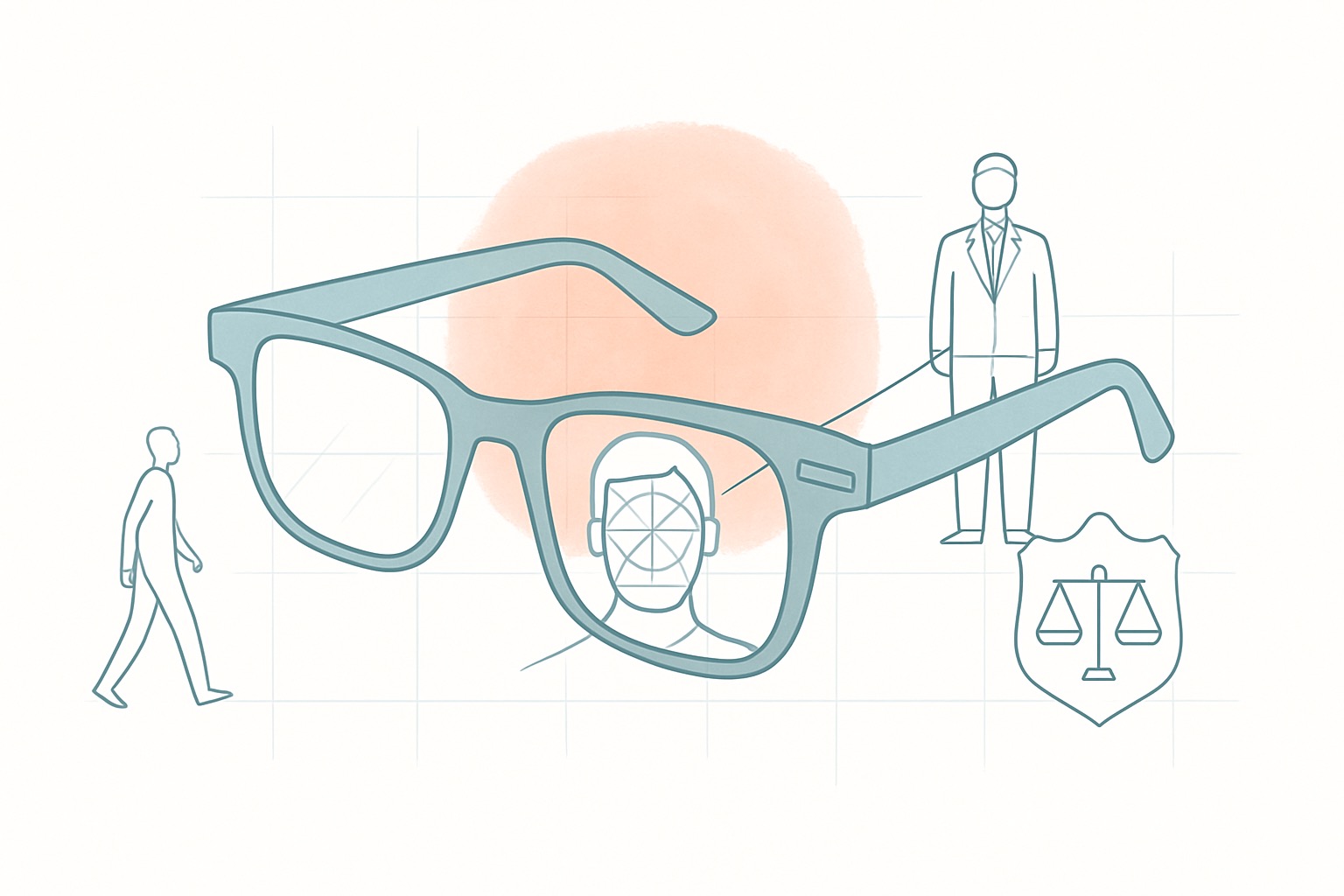
Norway Targets Facial Recognition in Smart Glasses
Norway's data protection authority is expanding biometric enforcement from fixed systems to wearable consumer devices as Meta, Ray-Ban, and emerging manufacturers bring facial recognition-enabled glasses to market.
The Norwegian DPA's position centers on real-time biometric surveillance in public spaces. Unlike security cameras, which are fixed, visible, and often disclosed through signage, smart glasses create mobile, covert biometric capture. The wearer becomes a walking surveillance node. Bystanders have no notice, no ability to avoid capture, no opportunity to consent.
This enforcement action signals a broader regulatory shift. European DPAs previously focused on institutional deployment, government surveillance systems, airport security, retail analytics. Consumer hardware wasn't the priority. That's changing. As wearable biometrics move from enterprise tools to consumer products, regulators are treating the threat model equivalently.
The technical capability is identical whether mounted on a wall or worn on a face. Meta's Ray-Ban Stories can capture faces, process recognition algorithms, and transmit biometric templates to cloud services. The device form factor doesn't change the GDPR Article 9 prohibition on biometric processing without explicit consent or legal basis.
Norway's action follows similar investigations in Italy and Germany. The Italian DPA questioned Meta's biometric data handling in Ray-Ban devices in May 2026. Germany's Conference of Data Protection Authorities issued guidance in July suggesting wearable biometrics may violate dignity protections under Article 1 of the German Constitution when used in public spaces.
Enterprise teams deploying wearable devices, AR headsets for warehouse operations, body cameras for security personnel, smart glasses for field service, face the same scrutiny. The Norway precedent suggests DPAs will apply institutional-grade compliance requirements to any biometric wearable, regardless of context. Expect consent requirements, impact assessments, and purpose limitation enforcement even for internal use cases.
The market signal is clear: European regulators won't distinguish between "consumer" and "enterprise" biometric devices. If it captures faces in real-time, it's subject to the strictest tier of data protection law.
Source: Biometric Update
USPS Ballot Tracking Creates Law Enforcement Database
The U.S. Postal Service finalized a rule requiring tracking systems for mail-in ballots that link ballot metadata to individual voters and make this data accessible to law enforcement without warrant requirements.
The rule, published August 15, 2026 under the Secure Mail Voting Act implementation framework, mandates Intelligent Mail Barcodes (IMb) on all ballot envelopes. Each barcode encodes a unique identifier linking to the voter's registration record. USPS systems track pickup, processing, and delivery events. The resulting database connects individual citizens to their voting participation status, timing, and geographic movement of their ballot through the postal system.
Law enforcement access operates through existing USPS cooperation protocols. The Postal Inspection Service maintains shared databases with federal law enforcement under the Mail Isolation Control and Tracking (MICT) program. The ballot tracking data flows into MICT infrastructure. No additional warrant requirement applies because USPS classifies the metadata as "mail cover" information, envelope exterior data historically available to law enforcement without judicial oversight.
This creates a searchable government database of voting participation linked to identity. Queries like "show all voters in zip code 10001 who returned ballots between October 15-20" become technically feasible. So do individual lookups: "did John Smith vote by mail in 2026?"
The Fourth Amendment question turns on expectation of privacy in ballot participation. Courts have historically protected ballot secrecy, the content of votes. But participation in voting has received less protection. Federal election law requires public voter rolls. Many states publish lists of who voted (not how they voted) as public records.
The USPS rule extends this from static participation records to timestamped, geographically tracked metadata. Law enforcement gains not just "did they vote" but "when did they request, receive, complete, and return their ballot" with location data at each step.
Civil liberties organizations argue this creates chilling effects on voting participation, particularly for communities already subject to heightened law enforcement scrutiny. The ACLU's comment on the proposed rule noted that immigrant communities, activists, and minority voters may face deterrence effects if ballot participation becomes part of law enforcement intelligence gathering.
The enterprise implication: government databases linking identity to constitutionally protected activities are expanding, setting precedent for other "metadata doesn't require warrant" arguments. HR teams tracking employee participation in internal surveys, compliance programs, or reporting mechanisms should expect similar logic: participation metadata may not receive the same protection as content.
For AI teams building employee monitoring or participation tracking systems: the USPS precedent suggests metadata linking individuals to protected activities (voting, reporting misconduct, accessing medical benefits) may be compelled without the same legal protections as the underlying activity content.
Source: Biometric Update
UK's First Age Verification Fine Signals Enforcement Era
Ofcom fined a geoblocked pornography website £300,000 for failing to implement age assurance systems, marking the first enforcement action under the Online Safety Act's age verification provisions and ending the regulatory guidance period.
The fine, issued August 22, 2026 against a site operating under UK jurisdiction through payment processing and UK-targeted content, establishes that geographic blocking alone doesn't satisfy age assurance requirements. The site had implemented IP-based geo-restrictions preventing UK access. Ofcom ruled this insufficient because VPN circumvention is trivial and the site made no attempt to verify user age even for UK traffic that bypassed blocks.
The enforcement action settles two questions that enterprise teams have been asking since the Online Safety Act implementation began:
First, what counts as "reasonable" age assurance? Ofcom's enforcement notice specifies that reasonable assurance requires "positive verification of age, not merely barriers to access." IP geoblocking, age checkboxes, and warning pages don't qualify. Acceptable methods include credit card verification (presuming 18+ cardholders), government ID verification through third-party services, or biometric age estimation tools that meet accuracy thresholds.
Second, when does guidance end and enforcement begin? The £300,000 fine came without warning beyond the general 90-day implementation period following regulations taking effect in May 2026. No additional guidance period. No escalating warning structure. Ofcom moved directly to financial penalties for sites that maintained "reasonable grounds to believe" UK users were accessing content without age verification.
This is the enforcement template for other biometric and age-gated systems in the UK. The Digital Markets, Competition and Consumers Act includes similar age-appropriate design provisions. The Data Protection Act includes age verification requirements for processing children's data. Expect parallel enforcement across these regimes using the Ofcom precedent: geographic blocking fails, self-declaration fails, financial penalties apply immediately post-implementation.
For enterprise teams: age-gated systems (gambling, age-restricted e-commerce, social platforms) in UK jurisdiction need technical verification, not trust-based controls. "Click here if you're 18+" won't survive enforcement. Neither will IP blocking.
The biometric question remains open. Ofcom's acceptable methods list includes facial age estimation, but doesn't specify whether this requires special category data protections under GDPR Article 9. The ICO hasn't issued coordinated guidance on whether age estimation biometrics trigger full biometric data regulations. Enterprise teams implementing age verification are navigating conflicting requirements: Ofcom requires strong verification, but biometric processing faces restrictions under data protection law.
The safest path: third-party age verification services that perform ID document checks without retaining biometric templates. These services exist (Yoti, Onfido, Jumio) and create separation between your platform and biometric processing. The verification service processes ID documents and returns a binary age assertion to your system. You never handle the underlying biometric data.
Source: Biometric Update
|
||||||||||
|
Fairness
Deepfake Evidence Used in Multiple Criminal Cases
Additional investigations reveal the incarceration case is not isolated, AI-generated fake evidence has been used in multiple criminal proceedings as courts struggle to establish authentication frameworks for synthetic content.
Reporting from Tampa Bay and Internewscast identifies at least three cases in Florida and Georgia where AI-generated text, audio, or image evidence was admitted in criminal proceedings during 2025-2026. In one Georgia case, AI-generated audio purporting to be a recorded confession was used in a domestic violence prosecution. Forensic analysis ordered by the defense after conviction determined the audio exhibited generation artifacts consistent with voice cloning models.
The pattern is consistent: synthetic evidence gets admitted under traditional authentication standards designed for analog recordings and human-created documents. Defense teams discover the fabrication post-conviction through technical analysis. Courts then face the procedural question of whether new evidence of AI generation warrants reversal or merely affects credibility.
Most concerning: in two of the documented cases, prosecutors appear to have been unaware the evidence was synthetic. The content was provided by law enforcement or third parties and presumed authentic. This suggests the problem isn't prosecutorial misconduct (though that may exist) but rather a systemic failure in evidence handling procedures.
No jurisdiction currently requires technical authentication of digital evidence before admission. Federal Rules of Evidence 901(a) requires only that "the proponent show that the item is what it claims to be." Visual inspection and circumstantial corroboration (e.g., the text messages align with other evidence) satisfy this standard. Generative AI has made visual inspection and circumstantial alignment trivially easy to fabricate.
The fairness dimension is stark: defendants with resources can hire forensic experts to challenge synthetic evidence. Public defenders lack budgets for these analyses. The Tampa Bay investigation found that in two cases, court-appointed defense counsel requested funds for digital forensics review and were denied. The synthetic nature of evidence was discovered only through post-conviction innocence projects, not during trial proceedings.
This creates a two-tier system: well-funded defendants get technical authentication; under-resourced defendants accept digital evidence at face value. Given that public defenders handle 80% of criminal cases in the U.S., the authentication gap affects the majority of criminal defendants.
Academic response is accelerating. The Quattrone Center for the Fair Administration of Justice at Penn Law released a policy brief in August 2026 calling for mandatory authentication protocols for digital evidence in criminal proceedings. Their proposal: any digital evidence in felony cases must undergo technical verification by a neutral expert before admission, with costs borne by the court system rather than defense budgets.
California's AB 2602, scheduled for implementation January 2027, moves partway there. It requires disclosure when a party knows evidence is AI-generated, but doesn't mandate technical verification. The burden remains on the party introducing evidence to know its origin, a standard that fails when synthetic content is provided by third parties or created by adversaries.
For enterprise teams conducting internal investigations: you operate under even lower evidentiary standards than criminal courts. Employment terminations based on digital communications, Slack messages, emails, text screenshots, currently require no technical authentication. If criminal courts are admitting fabricated evidence, your HR investigations are doing the same.
The solution isn't complex. Require digital forensics review for any high-stakes decision based on digital communications. Partner with providers who offer metadata analysis, generation artifact detection, and chain-of-custody verification. Budget $2,000-5,000 per investigation for technical review. The cost is less than one wrongful termination settlement.
Sources: AI Incident Database via Review of AI Law; Internewscast; Tampa Bay 28
|
||||||||||
|
Agency
German Constitutional Analysis Questions Palantir State Dependency
German legal scholars argue that state reliance on Palantir's proprietary surveillance systems creates asymmetric power where citizens become transparent to authorities while government becomes dependent on private technology it doesn't understand.
A three-part series in Verfassungsblog examines constitutional implications of German police agencies deploying Palantir Gotham for criminal investigations. The central argument: when the state delegates surveillance capabilities to private vendors operating proprietary systems, fundamental tensions emerge with constitutional requirements for democratic accountability and individual rights protection.
The first constitutional problem is organizational. Article 33(4) of the German Basic Law requires that sovereign functions, including criminal investigation authority, be exercised by public officials bound by public law duties. When Palantir operates algorithmic systems that determine investigative targets or analyze suspect relationships, scholars argue this crosses from tool provision into sovereign function exercise. The vendor makes classification decisions through algorithmic logic that state officials cannot audit or override.
The second problem is knowledge asymmetry. Government agencies using Palantir systems don't receive algorithmic transparency or system documentation sufficient to evaluate constitutional compliance. When courts review surveillance actions, the state cannot explain how algorithmic systems generated investigative leads or prioritized suspects. The vendor's IP protections prevent disclosure. This makes constitutional review impossible, courts cannot assess proportionality of surveillance measures when the state cannot explain how surveillance targets were selected.
The third problem is dependency. Once criminal investigation workflows integrate Palantir infrastructure, migration costs become prohibitive. Data architectures, analyst training, and investigative procedures all optimize around vendor-specific capabilities. The state loses sovereign capacity to conduct investigations using alternative systems. This dependency, termed "lock-in" in the private sector, becomes "democratic deficit" when applied to state functions.
The scholars propose three constitutional requirements for algorithmic state systems:
First, state officials must possess technical understanding sufficient to explain system decisions in constitutional review. "Unwissen schützt vor Verantwortung nicht", ignorance doesn't protect against responsibility. Agencies cannot claim they don't understand vendor algorithms as a defense against constitutional violations.
Second, algorithmic decision-making must remain subject to meaningful human review and override. This isn't the EU AI Act's "human-in-the-loop" requirement, it's a constitutional mandate that humans can reject algorithmic outputs based on fundamental rights considerations, even when the algorithm is technically correct.
Third, state dependency on private vendors for sovereign functions violates organizational law requirements for public control of state power. Criminal investigation capabilities must remain under public institutional control, even when implemented through contracted technology.
The enterprise parallel is direct. When your compliance team deploys third-party AI systems for fraud detection, anti-money laundering, or employee monitoring, you face identical questions: Can you explain the system's decisions to regulators? Can compliance officers override algorithmic outputs when individual circumstances warrant? Can you migrate to alternative systems without operational collapse?
The Palantir analysis suggests "we trust the vendor" doesn't satisfy accountability requirements. The German constitutional framework requires institutional capacity to understand, review, and override algorithmic systems, even when deployed by sophisticated private vendors.
For AI procurement teams: vendor transparency obligations should include technical documentation sufficient for legal review, not just operational training. Your contracts should specify that the organization retains authority to override algorithmic decisions based on legal or ethical review. And your enterprise architecture should prevent vendor lock-in from eliminating your ability to switch providers.
The constitutional analysis applies beyond Germany. EU AI Act Article 14 requires high-risk AI systems to be "sufficiently transparent to enable users to interpret the system's output and use it appropriately." This maps onto the German constitutional requirement for state understanding of algorithmic systems. Other EU member states will likely adopt similar interpretations.
Sources: Verfassungsblog (three articles examining Palantir constitutional questions)
|
||||||||||
|
Full Agenda
|
||||||||||
|
Further Reading
|
||||||||||
|