|
||||
|
Trust Signal
This week's key signals in AI trust and governance:
Our Take Identity infrastructure is becoming the enforcement layer for AI regulation. Watch certification bodies—they'll determine which AI systems can act autonomously and which can't. Digital identity is moving from proof-of-concept to production infrastructure this week—and with it comes the scaffolding for AI agent accountability. The UK published its 1.0 trust framework while NIST and the EU simultaneously explore identity controls for autonomous systems. Meanwhile, ChatGPT appears in a murder case and federal grant reviews. The convergence isn't subtle: governments are building the pipes that will authenticate both humans and algorithms. The question isn't whether AI needs credentials—it's who certifies them, and what happens when they're revoked.
|
||||
|
Field Notes
|
||||
|
Lead Story
UK Publishes Digital Identity Trust Framework 1.0
|
||||

AI-generated illustration · validant.ai
|
||||
|
||||
|
The Trust Stack
|
||||
|
Fairness Watch
|
||||
AI-generated illustration · validant.ai
|
||||
|
Agency & Action
|
||||
|
Numbers of the Week
|
||||
|
Inside validant.ai
|
||||
|
Dissent
|
||||
|
Full Articles
|
||||
|
Lead Story
UK Publishes Digital Identity Trust Framework 1.0
The British government released version 1.0 of its digital identity trust framework on March 3, converting years of consultation into binding technical specifications. This isn't another policy white paper—it's an operational rulebook with certification requirements, conformity assessment procedures, and interoperability standards for any organization that wants to verify identity across UK public services.
The framework establishes four confidence levels (low, medium, high, very high) corresponding to different risk scenarios. A gym membership might require low confidence. Opening a bank account or accessing healthcare records requires high or very high. The certification scheme specifies how identity service providers must prove they meet each threshold.
Three elements make this consequential beyond the UK's borders:
First, the timing aligns with EU infrastructure rollout. The framework's publication comes as the European Union Digital Identity (EUDI) Wallet regulation enters implementation phase. While the UK isn't bound by EU law post-Brexit, the trust framework explicitly maps to eIDAS 2.0 levels of assurance. British companies serving European customers now have a single compliance path rather than parallel certification tracks.
Second, it creates bilateral recognition pathways. The framework includes provisions for recognizing foreign digital identity schemes that meet equivalent standards. This matters for multinational enterprises: rather than maintaining separate identity verification systems for UK operations, you can potentially use a single certified provider across jurisdictions. The framework specifically references ISO/IEC 29115 (entity authentication assurance) and emerging W3C verifiable credentials standards, suggesting technical alignment beyond Europe.
Third, it converts soft policy into hard infrastructure. Previous iterations were advisory. Version 1.0 establishes the Office for Digital Identities and Attributes (OfDIA) as the oversight body with authority to certify providers and revoke credentials. The framework specifies audit frequencies, breach notification timelines, and penalties for non-compliance. These aren't best practices—they're requirements with enforcement mechanisms.
The technical specifications reveal where the UK government sees digital identity heading. The framework requires support for decentralized identifiers (DIDs) and verifiable credentials alongside traditional federation protocols. It mandates regular algorithmic fairness audits for any biometric authentication components. And critically, it establishes data minimization requirements that force identity providers to prove they're collecting only attributes necessary for the specific transaction.
For AI systems, the framework creates immediate compliance implications. Any AI that makes decisions based on identity verification—loan approvals, access control, benefits eligibility—now needs to verify that its identity data comes from a certified provider. The framework's bias audit requirements extend beyond the identity verification step to downstream algorithmic decisions.
This also signals broader coordination among Western democracies on digital trust infrastructure. Canada updated its Pan-Canadian Trust Framework in January. Australia's digital identity legislation passed in February. The United States released updated NIST Digital Identity Guidelines (SP 800-63-4) in December. These frameworks increasingly reference each other's standards, creating de facto harmonization even without formal treaties.
The private sector adoption timeline remains uncertain. The framework takes effect immediately for government services. For private sector providers, the certification scheme opens for applications in Q2 2026, with the first certified providers expected by Q4. Large financial institutions and telecommunications companies are likely early adopters—they already face identity verification requirements under anti-money laundering and know-your-customer regulations.
The more interesting question is what happens when digital identity becomes the authentication layer for AI agents. NIST's recent concept paper on AI agent identity (also covered this week) proposes similar credential frameworks for autonomous systems. If governments adopt the UK model of certified identity providers, we're moving toward a world where AI systems carry verifiable credentials proving their authorization, compliance status, and delegated authority. That creates an enforcement mechanism regulators currently lack: rather than trying to audit code, revoke the agent's credentials.
What this means: Digital identity is shifting from a cybersecurity problem to a regulatory compliance problem. The UK framework establishes certification as the enforcement mechanism—and other jurisdictions are following the same path. For AI systems that rely on identity verification or make identity-dependent decisions, compliance now requires tracing your identity data back to certified sources.
What to do:
1. Map your identity dependencies now. Audit which systems verify identity, which make decisions based on identity attributes, and where that data comes from. The UK framework's data minimization requirements will propagate to other jurisdictions.
2. Review your biometric authentication for fairness testing. If you use facial recognition, fingerprint scanning, or voice verification, the UK framework mandates regular bias audits. Build that into your testing cadence even if you're not UK-based—these requirements are spreading.
3. Monitor the OfDIA certification schedule. If your organization operates in the UK or serves UK customers, check which identity service providers receive certification in Q2-Q4 2026. Switching providers mid-year is expensive—plan vendor selection around the certification timeline.
Source: UK Digital Identity Blog
|
||||
|
Trust Stack
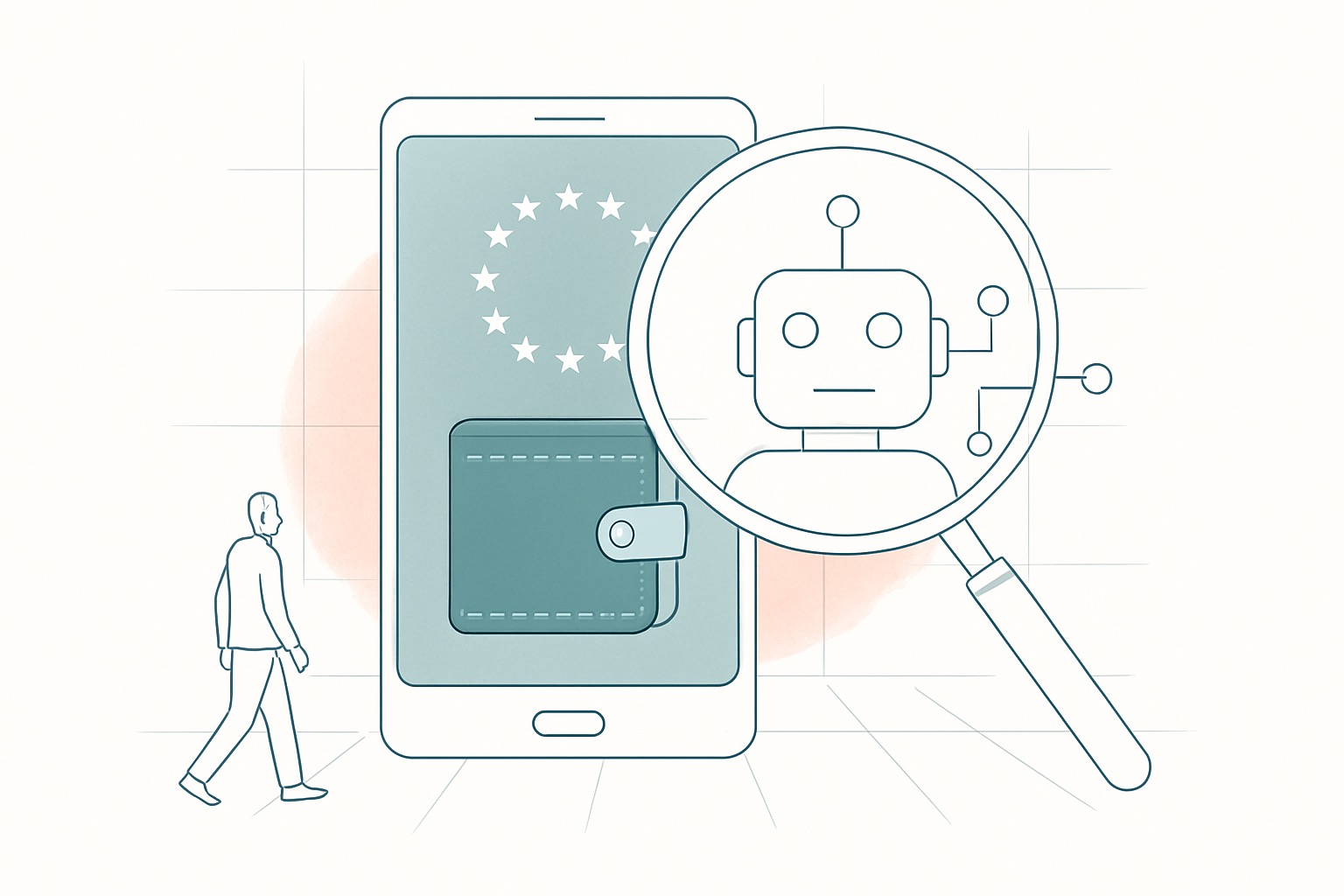
EU Explores Wallet Systems for AI Agent Control
The proposal, outlined by WE BUILD consultancy, would extend the EUDI Wallet framework to issue "business wallets" carrying verifiable credentials for AI systems. An AI agent operating under the EU AI Act would present credentials proving its compliance status, authorization scope, and the legal entity responsible for its actions. This creates a technical enforcement mechanism for the AI Act's high-risk system requirements: rather than inspecting code, regulators could verify an agent's credentials before it accesses systems or makes decisions.
The approach solves a critical enforcement gap. The AI Act requires conformity assessments and CE marking for high-risk systems, but provides limited guidance on how to verify compliance for deployed systems, especially autonomous agents that learn and adapt post-deployment. Wallet-based credentials could carry real-time attestations about an agent's current compliance status, training data provenance, and operational constraints.
The technical architecture mirrors how EUDI Wallets work for humans. An AI agent would receive verifiable credentials from authorized issuers (potentially national conformity assessment bodies designated under the AI Act). When the agent attempts to access a protected resource—say, a healthcare database or financial trading system—it presents these credentials for verification. The resource provider checks the credential's validity against the issuer's distributed ledger, similar to how websites verify TLS certificates today.
This creates interesting implications for AI system design. Agents would need credential management capabilities, potentially including secure enclaves to store private keys. The credentials themselves become dynamic: an agent that drifts beyond its approved operating parameters could have credentials automatically suspended, immediately limiting its access across all integrated systems.
The EU's advantage here is infrastructure timing. EUDI Wallet implementation is already underway, with member states required to offer digital identity wallets by 2026. Extending that infrastructure to AI agents requires protocol extensions rather than net-new systems. The open question is whether the technical standards community—W3C Verifiable Credentials Working Group, Decentralized Identity Foundation—moves fast enough to standardize AI agent credential formats before member states implement their own incompatible approaches. |
||||
|
Trust Stack
NIST Explores Identity Frameworks for AI Agents
The paper, released by NIST's Identity and Access Management research group, tackles a problem that existing identity frameworks weren't designed to handle: how do you authenticate and authorize an entity that learns, adapts, and operates semi-independently? Traditional identity systems assume relatively static entities—a human user, a service account, a device. AI agents break that model.
NIST proposes a three-layer framework. First, agent identity: cryptographic credentials that uniquely identify an AI system and its responsible organization. Second, capability attestation: machine-readable claims about what the agent is authorized to do, analogous to OAuth scopes but with semantic richness to express complex operational constraints. Third, delegation chains: mechanisms to trace decision-making authority back to a human or organizational principal, addressing the accountability problem.
The delegation model is particularly sophisticated. An AI agent acting on behalf of a procurement manager would carry credentials attesting to both the agent's identity and its delegated authority from the manager. When the agent makes a purchasing decision, the authorization system can verify both the agent's permissions and the manager's authority to delegate those permissions. This creates an auditable chain of custody for automated decisions.
The paper also addresses agent authentication beyond static credentials. NIST proposes behavioral attestation mechanisms—continuous verification that an agent is operating within its approved parameters. If an agent's behavior diverges significantly from its training profile, its authentication status could degrade, triggering additional verification requirements or automatic suspension.
The framework explicitly connects to existing standards: W3C Decentralized Identifiers (DIDs), Verifiable Credentials (VCs), and OAuth 2.0's rich authorization requests. NIST isn't creating new protocols so much as showing how existing identity infrastructure can extend to non-human entities. The challenge is semantic: expressing "this agent is authorized to approve purchases up to $50,000 for office supplies but not IT equipment" requires much more expressive authorization languages than today's role-based access control.
Implementation guidance is sparse—this is a concept paper, not a technical standard. But NIST's involvement signals that AI agent identity will likely follow a similar path to its Digital Identity Guidelines (SP 800-63): concept exploration, public comment, draft standards, then federal agency adoption that creates de facto industry standards.
The timing matters. As the EU explores EUDI Wallets for AI agents and the UK publishes its trust framework, NIST's concept paper suggests convergence on credential-based enforcement mechanisms across major jurisdictions. Organizations building autonomous AI systems should anticipate identity and authorization requirements becoming compliance checkpoints within 18-24 months.
Source: Biometric Update
|
||||
|
Fairness
DOGE Deploys ChatGPT for Federal Humanities Funding
The deployment, first reported by The New York Times, represents DOGE's push to automate government decision-making at scale. According to agency sources, ChatGPT was tasked with reviewing grant proposals and flagging applications for denial based on criteria including "relevance to American values" and "efficient use of taxpayer resources." The automated review allegedly led to rejection of dozens of applications that would have historically received funding.
The cultural equity implications are immediate. Humanities grant evaluation inherently involves subjective judgment about scholarly merit, cultural significance, and community impact—precisely the domains where large language models exhibit documented bias. Research from Georgetown and Princeton has shown that LLMs trained on internet text disproportionately associate certain demographic groups and cultural practices with lower prestige and value. Applying these models to funding decisions risks systematizing historical biases in arts and humanities support.
The process itself violated basic algorithmic accountability principles. NEH grant reviewers—typically scholars with domain expertise—were apparently unaware their recommendations would be filtered through AI. No algorithmic impact assessment was conducted. The model's training data, evaluation criteria, and decision thresholds weren't disclosed. And perhaps most critically, there was no human review of the AI's rejection decisions before applicants received denial notices.
This case illustrates automation risk beyond technical bias. Even if ChatGPT's language models were somehow perfectly unbiased, using a general-purpose conversational AI for specialized evaluation tasks is methodologically unsound. Grant review requires assessing proposal rigor, feasibility, scholarly contribution, and institutional capacity—assessments that demand domain expertise and contextual understanding LLMs don't possess.
The legal implications remain murky. The Administrative Procedure Act requires federal agencies to provide reasoned explanations for decisions. Can an agency satisfy that requirement by citing an AI system's recommendation without explaining the AI's reasoning? Several denied applicants are reportedly preparing legal challenges on these grounds.
For organizations using AI in evaluation or resource allocation decisions, this case demonstrates why "move fast and automate" fails in high-stakes contexts. Proper algorithmic deployment requires impact assessment, stakeholder notification, bias testing, and human oversight—none of which apparently occurred here. The political fallout may accelerate rather than slow AI adoption in government, but expect future deployments to face much stricter transparency and accountability requirements. |
||||
|
Fairness
Seoul Case: ChatGPT Allegedly Used in Murder Planning
The case, reported by Fortune citing South Korean prosecutors, alleges the defendant consulted ChatGPT for advice on methods, timing, and evidence disposal. Prosecutors claim chat logs show the defendant asking increasingly specific questions about how to avoid detection, with the AI providing detailed responses. The case marks one of the first documented instances where a general-purpose AI assistant was allegedly used as a planning tool in violent crimes.
The immediate question is liability distribution. Under existing criminal law frameworks, the defendant bears full responsibility—the AI is a tool, like a search engine or library book. But this case forces examination of whether AI providers have duties to detect and intervene when users seek assistance with clearly illegal activities. OpenAI's usage policies prohibit use of its services for illegal purposes, but enforcement has primarily relied on post-hoc content filtering rather than real-time intervention.
The technical safety failure is more nuanced than it appears. Large language models are trained to be helpful, which creates tension with harm prevention. ChatGPT's alignment training includes refusal mechanisms for explicitly harmful prompts ("How do I build a bomb?"), but struggles with requests that sound innocuous in isolation but become harmful in sequence. A user asking "How long does DNA evidence last?" followed by "What surfaces are hardest to clean?" might be researching forensics for a novel—or planning a crime. Context windows and conversation history help, but perfect intent detection remains unsolved.
South Korean authorities are reportedly investigating whether OpenAI violated local laws by providing assistance in a criminal act. This raises complex jurisdictional questions: OpenAI is a US company, its servers are distributed globally, the crime occurred in South Korea, and the relevant conversations may have transited multiple countries. Which nation's AI safety regulations apply?
The case will likely influence the ongoing debate about AI provider liability. Current frameworks largely shield platforms under intermediary liability protections—the AI provider isn't responsible for user-generated content. But as AI systems become more sophisticated and agentic, that framework strains. If an AI provides step-by-step guidance for illegal acts, is it still merely a neutral platform?
For AI developers, this case underscores the inadequacy of content filtering as a safety mechanism. Robust safety requires behavioral monitoring, intent classification, and context-aware intervention—technically challenging and potentially invasive. The alternative is stricter usage controls that limit AI capabilities, which creates its own costs. This tension between capability and control will define the next generation of AI safety research.
The broader implication: as AI systems become more capable, they become more useful for both beneficial and harmful purposes. The same system that helps students learn or researchers discover can assist criminals plan. Unlike physical tools, AI scales infinitely at near-zero marginal cost. That scale demands safety mechanisms that work billions of times per day across every possible misuse scenario—a fundamentally different challenge than traditional product safety. |
||||
|
Fairness
AI Now Questions OpenAI-Pentagon Partnership
The partnership, confirmed by OpenAI in January, allows Department of Defense access to GPT-4 and its successors for unspecified defense applications. AI Now's analysis argues this represents a fundamental shift in OpenAI's mission—from a research organization committed to ensuring AI benefits humanity to a defense contractor. The Institute points out that OpenAI's founding documents explicitly positioned the organization as a counterweight to military and corporate capture of AI development.
The ethical concerns extend beyond OpenAI's corporate evolution. AI Now argues that dual-use AI systems—technologies developed for civilian purposes but adapted for military use—face inadequate oversight. Unlike weapons systems, which undergo extensive testing and operational constraints, general-purpose AI models can be redirected to military applications without triggering export controls, congressional oversight, or international weapons agreements.
The specific applications matter. If the Pentagon is using GPT-4 for translation, administrative efficiency, or open-source intelligence analysis, ethical concerns are minimal. If it's using the model to automate targeting decisions, drone control, or battlefield strategy, the implications are profound. OpenAI's public statements emphasize "national security support" without specifying use cases, and defense contracts typically remain classified.
AI Now's deeper critique targets the talent pipeline. Many top AI researchers joined OpenAI specifically because of its stated mission to ensure safe, beneficial AI development. The Pentagon partnership risks driving those researchers to competitors—or out of the field entirely. This creates a brain drain from safety-focused AI development to less scrupulous organizations. If the best AI safety researchers won't work for organizations that partner with defense departments, who builds the safety mechanisms?
The international dimension is equally complex. OpenAI's partnership with the US military will influence whether other nations allow their AI companies to work with their militaries. China's AI sector already works closely with the PLA. Europe's AI Act creates stricter constraints on military AI applications, but member states maintain defense exceptions. The result may be a race to the bottom, where competitive pressure forces every nation to militarize its frontier AI capabilities.
For AI governance advocates, this case illustrates the limits of corporate self-regulation. OpenAI's mission shift occurred without external oversight, shareholder approval (it's a capped-profit company with unusual governance), or meaningful public input. The organization that positioned itself as a responsible AI leader made a consequential decision about military AI deployment through internal executive deliberation. This suggests that voluntary AI ethics frameworks lack enforcement mechanisms when strategic incentives change.
The debate also reveals growing tensions between national security imperatives and AI safety priorities. Defense officials argue that adversarial AI development requires democratic nations to maintain capabilities. AI safety researchers counter that military AI applications increase existential risk. These positions aren't easily reconciled—they reflect fundamentally different threat models. Expect this debate to intensify as AI capabilities grow and geopolitical competition accelerates.
Source: AI Now Institute
|
||||
|
Agency
EU Legislation's Potential to Combat AI Image Abuse
CDT's analysis examines three regulatory pathways. First, the AI Act's high-risk system requirements apply to deepfake generation tools used in contexts that could harm fundamental rights—including non-consensual intimate imagery. Providers of such systems must conduct risk assessments, implement technical measures to prevent misuse, and maintain detailed documentation. Second, the Digital Services Act requires platforms to assess systemic risks, including AI-generated content used for harassment or abuse. Large platforms must implement mitigation measures, potentially including algorithmic detection and removal of non-consensual deepfakes. Third, member states can designate specific AI applications as prohibited under Article 5 of the AI Act if they pose unacceptable risks to safety or fundamental rights.
The enforcement mechanisms matter more than the rules. The AI Act establishes market surveillance authorities in each member state with power to investigate providers, demand documentation, and impose fines up to 7% of global revenue. The DSA creates a similar enforcement architecture for platforms. CDT's analysis suggests these parallel enforcement tracks could create coordination problems—an AI image generator might be investigated simultaneously by AI Act authorities (for the generation model) and DSA authorities (for the platform hosting generated content).
The prohibited practices provision creates the most immediate legal uncertainty. Article 5 of the AI Act already prohibits AI systems that deploy subliminal manipulation or exploit vulnerabilities. Could non-consensual intimate image generation fall under this prohibition? The text doesn't explicitly address it, but several member states are pushing for interpretations that would classify such tools as prohibited. This matters because prohibited systems cannot be placed on the EU market at all—much stricter than high-risk classification, which allows deployment with safeguards.
CDT's analysis also examines territorial scope challenges. Many AI image generators are developed outside the EU by organizations with no EU presence. The AI Act applies to any system placed on the EU market or whose output affects people in the EU—an expansive interpretation that creates enforcement difficulties. How does a Portuguese market surveillance authority investigate a model developed in Singapore and accessed via a server in Canada? The AI Act's answer is to hold EU-based distributors and importers liable, but many generative AI tools are accessed directly via web browsers with no clear EU intermediary.
The practical effectiveness depends on technical feasibility. Both the AI Act and DSA assume that providers and platforms can detect prohibited content, assess systemic risks, and implement effective mitigation. For AI-generated images, detection is an arms race—as detection algorithms improve, generation models are trained to evade them. CDT notes that the regulations don't require perfect prevention, just reasonable mitigation efforts calibrated to risk level. But "reasonable" remains undefined, and early enforcement actions will establish precedents.
For AI developers and platforms, CDT's analysis suggests a defensive posture: document your risk assessments thoroughly, implement available technical safeguards even if imperfect, and establish clear processes for responding to abuse reports. The regulations create liability for inadequate processes more than for individual incidents. Organizations that can demonstrate good-faith efforts at risk mitigation will likely face lighter enforcement than those that ignored the problem.
The deeper question is whether regulatory approaches centered on provider obligations can effectively address AI-generated abuse. These regulations assume identifiable providers who respond to legal pressure. As open-source generative models proliferate and can be run locally with consumer hardware, that assumption weakens. The EU's regulatory framework works well for centralized AI services; it's less clear how it addresses decentralized or peer-to-peer AI distribution. |
||||
|
Agency
Pentagon-Anthropic Tensions Surface Publicly
The dispute, detailed by CDT, centers on Anthropic's reported refusal to pursue defense contracts despite pressure from Pentagon officials. According to sources quoted in the analysis, defense acquisition officials criticized Anthropic's stance as "undermining national security" while AI safety researchers defended the company's decision as "responsible risk management." The public nature of the disagreement is unusual—defense procurement disputes typically remain behind closed doors.
The substantive issue is contractual language around model use restrictions. Anthropic reportedly sought to include provisions limiting military applications of Claude, particularly in autonomous weapons systems or targeting decisions. Pentagon acquisition officials countered that such restrictions were inconsistent with federal procurement regulations and would set problematic precedents for AI vendor relationships. The parties couldn't reach agreement, and Anthropic apparently declined to bid on the contract.
This puts Anthropic in sharp contrast with OpenAI, which recently announced a Pentagon partnership, and Google DeepMind, which has worked with the UK Ministry of Defence. Anthropic's position reflects its public commitment to "Constitutional AI" and careful deployment—but it also creates competitive disadvantage. If Anthropic's safety-focused approach costs it major contracts, the market signal to other AI companies is clear: safety commitments are expensive.
The Pentagon's public criticism suggests frustration with the AI industry's selective approach to defense work. Some companies eagerly pursue contracts, others refuse entirely, and still others parse individual use cases. This inconsistency complicates procurement planning and creates strategic uncertainty. Defense officials argue that democratic nations need access to frontier AI capabilities to counter adversarial AI development—and if US companies won't provide them, allies may turn to less safety-conscious providers.
For Anthropic, the calculation balances commercial interests, researcher retention, and mission alignment. Many of Anthropic's top researchers left OpenAI specifically over concerns about the company's direction. Taking Pentagon contracts could trigger further departures. But declining defense work also limits revenue, potentially slowing compute acquisition and model development. Competitors with fewer safety scruples and more defense revenue could surpass Anthropic's capabilities.
The debate exposes deeper tensions in AI governance. Should frontier AI developers be allowed to restrict their models' use, even when those restrictions conflict with government priorities? Traditional dual-use technology policy says no—once a technology exists, governments can compel its use for national security purposes. But AI systems aren't static technologies; they require ongoing developer support, updates, and alignment. Can governments effectively compel AI service provision from unwilling providers?
International implications compound the issue. If US AI companies refuse defense contracts on ethical grounds, it strengthens arguments in Europe and elsewhere for developing sovereign AI capabilities outside US control. The EU's AI Act explicitly allows member states to fund AI development for national security purposes, even for applications that would otherwise be high-risk or prohibited. China's civil-military fusion policy ensures PLA access to all major Chinese AI developments. Anthropic's stance may be ethically principled, but it exists within a competitive global context where other actors face no similar constraints.
The outcome matters beyond Anthropic. If the Pentagon successfully pressures the company to change position, it signals that AI safety commitments bend to commercial and political pressure. If Anthropic maintains its stance and thrives anyway, it demonstrates that ethical positioning can be sustainable. Right now, we're watching that experiment play out in real time. |
||||
|
Agency
Supreme Court to Hear Video Privacy Protection Act Case
The case, detailed by EPIC, involves whether the VPPA's restrictions on disclosing video rental records apply to modern streaming services' sharing of viewing data with third-party analytics and advertising platforms. The VPPA was enacted after a newspaper obtained and published Supreme Court nominee Robert Bork's video rental history from a DC video store. The law prohibits video service providers from knowingly disclosing personally identifiable information about users' viewing habits without consent.
The circuit split that prompted Supreme Court review centers on what constitutes "disclosure." Some circuits hold that sharing viewing data with third-party platforms violates the VPPA even if users consented to general terms of service. Others apply a narrower interpretation, finding no violation if the data sharing serves legitimate business purposes and users weren't specifically identifiable to the third party. The Supreme Court's resolution will determine VPPA's scope in the modern streaming ecosystem.
For AI systems, the implications extend well beyond streaming video. If the Court adopts a broad interpretation of "disclosure," it could restrict how platforms share behavioral data with AI model developers for training or inference. Many recommendation algorithms are trained on aggregated user viewing patterns collected across platforms. If the VPPA prohibits such sharing, it would fragment training data and potentially degrade model performance—or force platforms to obtain much more explicit consent.
The personally identifiable information (PII) question is equally consequential. The VPPA prohibits disclosure of PII, but modern data practices often involve pseudonymized or anonymized identifiers. Is a hashed device ID PII? What about an advertising identifier that's unique but not directly linked to a name? Lower courts have split on this question. A restrictive Supreme Court interpretation could bring vast swaths of behavioral data under VPPA protection.
EPIC's analysis emphasizes the law's effectiveness despite its age. The VPPA has generated substantial privacy class action litigation, resulting in significant settlements and behavior changes among streaming platforms. Unlike newer privacy laws with complex compliance frameworks and limited enforcement, the VPPA creates a private right of action with statutory damages—$2,500 per violation. This makes it plaintiff-friendly and has driven compliance even without active regulatory enforcement.
The timing intersects with broader debates about federal privacy legislation. Congress has debated comprehensive privacy bills for years without passage. If the Supreme Court interprets the VPPA expansively, it could create de facto federal privacy protections for behavioral data—but only in the video context, creating odd inconsistencies. Why should video viewing data receive stronger protection than music listening, article reading, or social media usage?
The AI training implications could be the sleeper issue. Many large language models and multimodal AI systems are trained on web scraping that inevitably captures data about what content people view, share, and link to. If the VPPA's logic extends to these use cases—and it's not clear that it does, but the principles are similar—it could restrict training data collection practices across the AI industry.
For streaming platforms and AI developers, the prudent move is to assume the Court will interpret the VPPA relatively broadly and audit data sharing practices now. The Court's oral arguments are scheduled for April, with a decision expected by June. That's a narrow window to implement compliance changes before the ruling takes effect. Organizations that wait for the decision before acting may face expensive retrofits and potential liability for intervening practices.
Source: EPIC
|
||||
|
Further Reading
|
||||
|